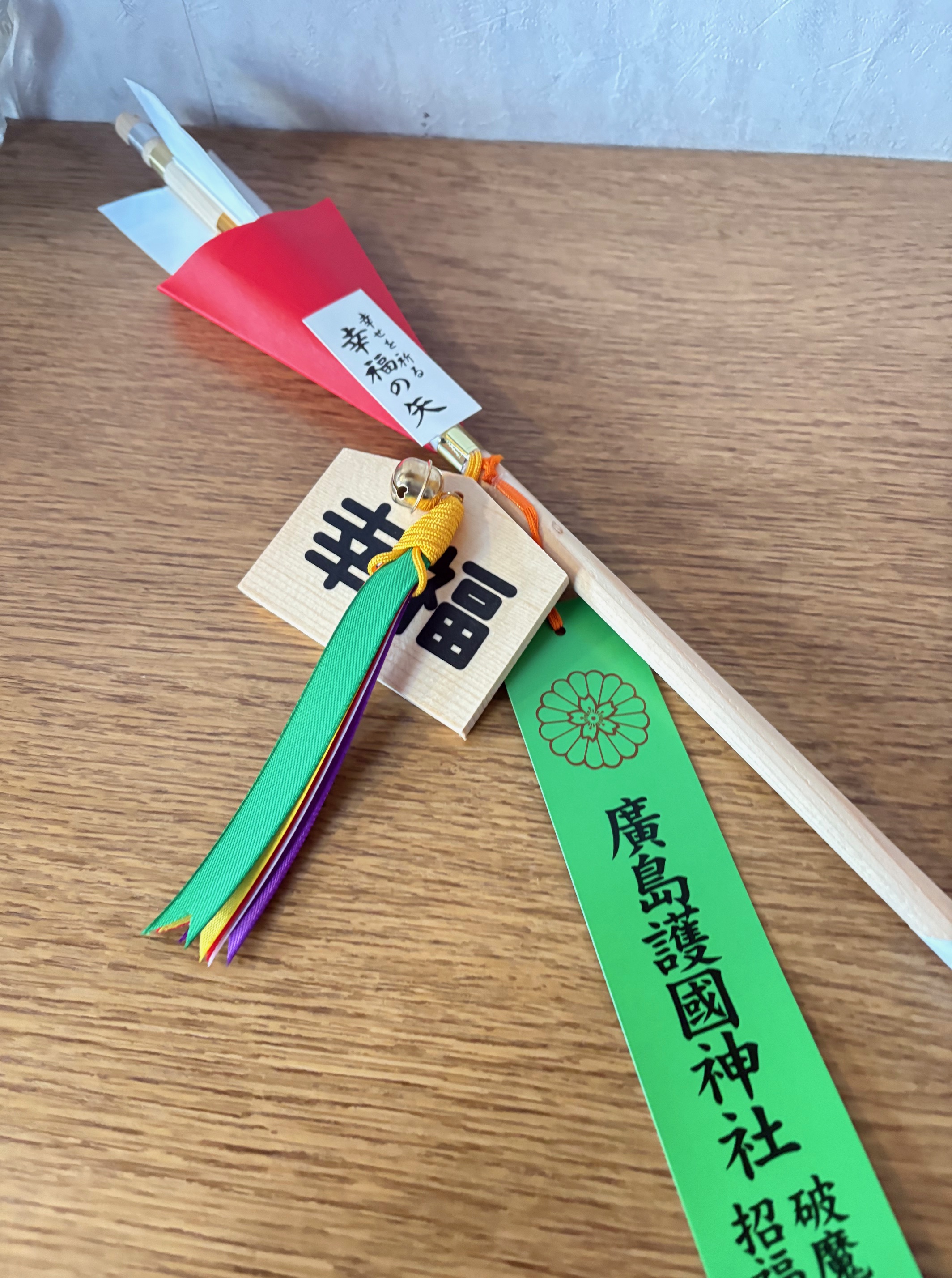
If you visit Japan around New Year,
you may notice something curious.
Many Japanese people are walking around holding
a stick-shaped object with a small bell attached.
You might wonder:
- What is that stick?
- Why are they carrying it?
- Where are they going?
This object is called a Hamaya.
What Is a Hamaya(破魔矢)?
A Hamaya is a traditional Japanese New Year charm,
usually obtained at a Shinto shrine during Hatsumōde
(the first shrine visit of the year).
The word Hamaya means
“an arrow that wards off evil.”
It is believed to symbolize:
- Protection from bad luck
- A peaceful year ahead
- A fresh start for the new year
The bell attached to it is important.
In Japanese culture, the sound of a bell is thought to purify a space and drive away negative energy.
There Are Different Types of Hamaya Depending on the Purpose
Hamaya are traditional ceremonial arrows given at Japanese shrines during the New Year.
Rather than “any one is fine,” Japanese people select a Hamaya based on what they want to pray for in the coming year.
Below are some of the most common types:
- Health (健康祈願 / Kenkō Kigan)
A Hamaya chosen to pray for good health and to avoid illness throughout the year.
Many people select this type for themselves or for their family members. - Happiness / Good Fortune (幸福・開運 / Kōfuku・Kaiun)
This type is meant to improve overall luck and well-being.
It is often chosen by people who are unsure which Hamaya to select and want general good fortune. - Protection / Evil Warding (厄除け・災難除け / Yakuyoke)
A Hamaya intended to ward off misfortune, bad luck, and negative influences.
Protection from unseen troubles is an important concept in Japanese culture. - Success / Study (仕事運・学業成就)
Chosen by students preparing for exams or by people starting a new job or career.
It represents wishes for progress, achievement, and personal growth. - Family Safety (家内安全)
This Hamaya is selected with the household in mind rather than an individual.
In Japan, prayers are often made for the safety and well-being of the entire family.
Why Are People Carrying It Outside?
At the beginning of the year, many Japanese people:
- Visit a shrine
- Return the previous year’s Hamaya
- Receive a new one for the coming year
That is why you often see people
walking away from shrines holding a Hamaya in their hands.
They are simply taking it home.
What Happens to the Old One?
Hamaya charms are generally kept for one year.
When the year ends, people bring them back to the shrine,
where they are respectfully burned or purified in a ritual.
This is not about superstition,
but about closing one year properly and starting the next with intention.
How Much Does a Hamaya Cost?
Prices vary depending on the shrine and design,
but generally:
- Around 1,000 yen for a basic Hamaya
- Larger or more decorative ones can cost more
There are usually no very cheap options.
The price reflects tradition, not luxury.
People choose one that feels right to them,
not based on how expensive it is.
Why Do Japanese People Buy It?
A Hamaya is not a magic item.
Most Japanese people do not believe
that it guarantees safety or luck.
Instead, it represents:
- A yearly reset
- A moment to reflect
- A symbol of personal responsibility for the coming year
In a practical sense,
it is a cultural way to mark time and renew one’s mindset.
Final Thoughts
Seeing Japanese people walk around with
a bell-attached stick at New Year
may look mysterious at first.
But it is simply part of a long-standing tradition
that blends culture, routine, and quiet reflection.
Understanding small details like this
can make your New Year visit to Japan
feel richer and more meaningful.